Plan International’s Voice, Choice and Power report captured the realities and ambitions of girls across the Asia-Pacific region. It ranked 33 countries and territories on education, protection, political representation, economic opportunities, health, and law and policy. The insights mattered. But research like this can sit unread in policy circles, so Plan International brought us in to help.
We designed a girls rights campaign that would carry the report’s findings beyond policy circles and into public conversation. The brief called for content that celebrated girl activists while exposing the opportunity gaps they face. We developed the creative concept and messaging from the ground up, working within Plan International’s existing brand identity to keep the campaign consistent with their global presence.
Bringing girls’ own stories to the front
We brought forward a wide range of girls’ stories from across the region. Each one gave a different lens on the barriers girls face, and the ways they are already pushing past them.
The stories covered menstrual stigma and exile, the strength of youth-led advocacy, and the realities of continuing activism through the pandemic. Others followed girls fighting their own child marriages and refusing to stay silent about it.
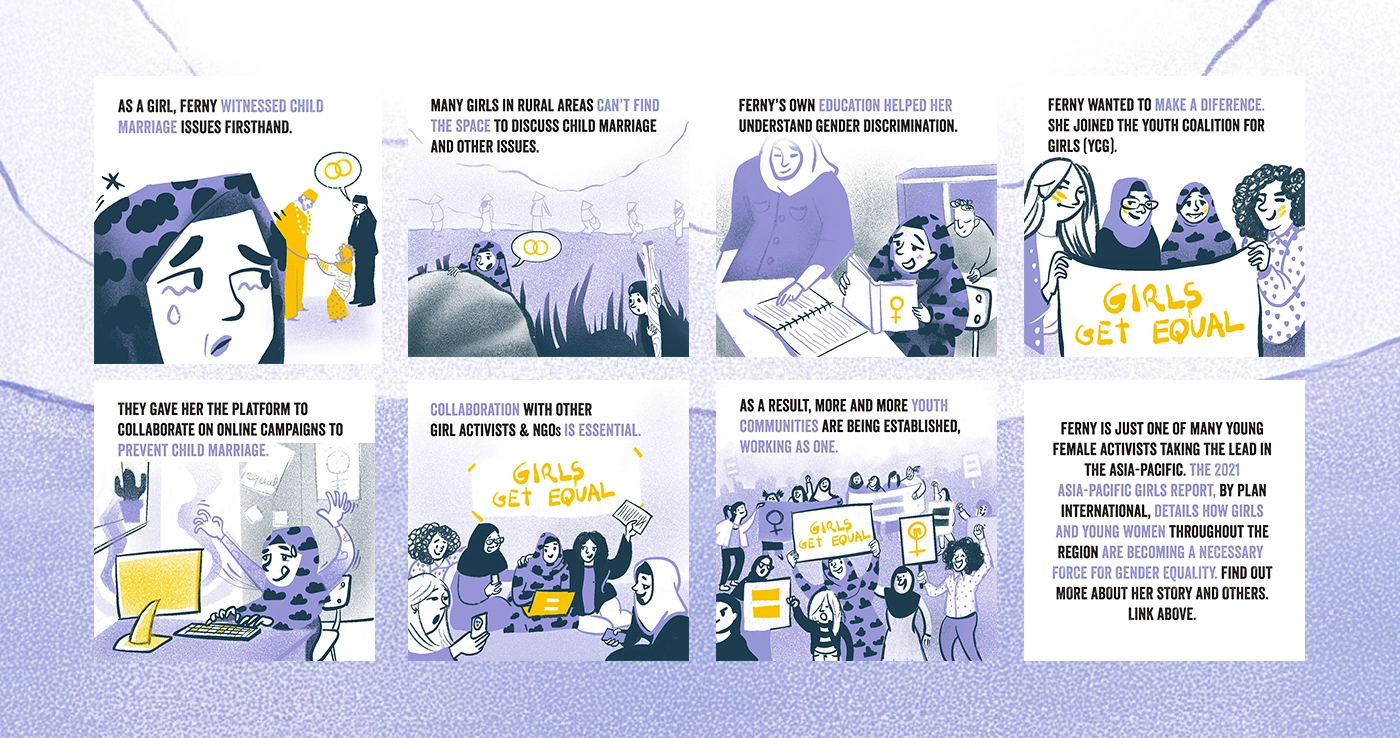
Alongside the stories, we developed a set of comics following young female activists as they push for change in their own communities.
Turning the report into shareable content
We built a social media plan of tailored posts, supported by blog content, a one minute video summarising the report, and Instagram quizzes. Content spotlighted the countries and territories leading the region’s Girls’ Leadership Index rankings.
Campaign hashtags, including #VoiceChoicePower, #girlsgetequal and #Plan4Girls, carried the content across Plan International’s global, regional and country office channels. The social media plan included a set of human interest stories that we wrote to strengthen the campaign’s advocacy voice. Each one kept girls at the centre of their own narratives throughout.
Seven Plan International country offices joined the campaign, sharing tailored content across their own channels. The campaign generated over 902,000 impressions and reached more than 812,000 people on Facebook and Twitter. The comics performed particularly well: one Plan Asia-Pacific Facebook post sharing drew over 3,400 likes on its own.
Getting the report in front of policy makers
Social reach alone doesn’t always move governments. To put the report’s findings in front of policy makers, we needed it covered by the outlets they actually read.
We built a press kit for the launch, including a press release, Q&As and fact sheets, and pitched op-eds to key media across the region. We also organised a regional digital press conference to brief journalists directly on the report’s rankings and recommendations. The strategy placed the report firmly in mainstream media, the channel most likely to reach decision makers. The launch generated coverage across 11 countries, with 39 news articles and 14 editorials published on major regional platforms including the South China Morning Post, The Jakarta Post, The Straits Times, The Bangkok Post, PhilStar Global and The Star (Malaysia).
***